On platforms like Meta, TikTok, and Google, the "black box" of automated targeting usually outperforms manual tinkering. Consequently, the primary lever for performance marketers has shifted from technical campaign structure to the creative itself. But here lies the modern bottleneck: creative production hasn't kept pace with algorithmic consumption.
The typical design cycle—requesting a variant, waiting for a designer to re-render or re-edit, and then pushing to production—often takes three to five days. By the time a "Version B" is live, the creative fatigue on "Version A" has already spiked. To win in current ad auctions, marketers need a "speed to insight" that matches the speed of the feed. This requires moving away from slow, batch-based production toward a responsive workflow powered by generative models like Nano Banana Pro and integrated editing suites.
The Production Paradox in Modern Performance Marketing
There is a widening gap between what the algorithm needs and what a traditional creative team can feasibly deliver. Modern ad platforms require a high volume of diverse assets to combat creative fatigue and to give the machine enough data points to find "pockets" of high-intent users. If you only test three images a week, your probability of finding a statistical winner is low. If you test thirty, your odds improve dramatically.
The paradox is that while we need more volume, we cannot afford to sacrifice quality. Low-quality, "uncanny valley" AI assets can damage brand equity and trigger policy flags on ad platforms. The goal isn't just to produce more; it’s to iterate on a hypothesis faster. This means shortening the distance between a "What if we tried a coastal background?" thought and a high-fidelity asset ready for the Ads Manager.
Marketers are now shifting from the "big idea" model—where one hero asset is polished for weeks—to an "iterative hypothesis" model. In this new framework, the generative model acts as the engine for exploration, while the marketer acts as the director, refining the output until it hits the specific aesthetic requirements of the brand.
Generating Hero Concepts with Nano Banana Pro
The foundation of any successful campaign is the "Hero" concept. This is the baseline visual that establishes the product’s placement, the lighting, and the overall mood. Using a model like Nano Banana Pro allows marketers to establish this foundation in minutes rather than hours of stock photo searching or expensive studio photography.
The tactical advantage here is not just speed, but the ability to discover "happy accidents." When you prompt for a product in a specific setting—for example, a high-end skincare bottle on a minimalist marble vanity—the model might generate a specific refraction of light or a unique floral arrangement in the background that you hadn't originally planned for. These unexpected visual elements often end up being the "hook" that stops the scroll.
To maintain a professional standard, marketers should use the Nano Banana model to build a library of base assets. Instead of generating a single image, you generate a spectrum of compositions. One might be a tight macro shot, another a lifestyle placement, and a third a flat-lay. This "base library" serves as the raw material for the next, more surgical phase of the creative process: the iteration.
Surgical Iteration: Refining Visual Hypotheses with Banana AI
Once a hero concept is established, the real work of performance marketing begins. This is where you test variables. Does the product perform better in a brightly lit kitchen or a moody, sunset-lit dining room? Does a blue color palette drive more clicks than a warm orange one?
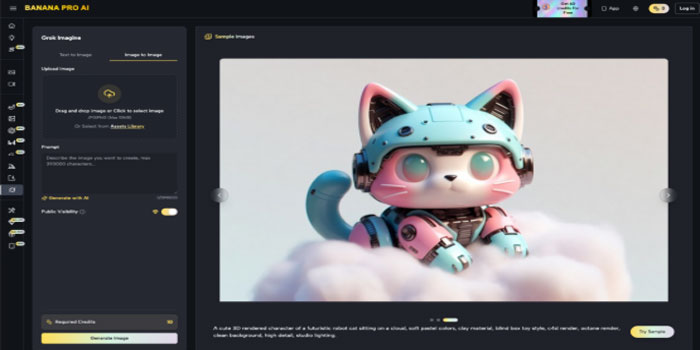
Using Banana AI, marketers can perform these surgical edits without needing to re-prompt the entire image from scratch. The primary tool here is the image-to-image workflow. By uploading a base hero asset, a marketer can keep the core product consistent—essential for brand integrity—while asking the AI to swap the background or change the lighting conditions.
This level of control is where most generative tools fail. If the AI changes the label on your product or alters the shape of your packaging, the ad is useless. Therefore, the use of a dedicated AI Image Editor becomes mandatory. You aren't just generating; you are "masking" and "inpainting." You might take a high-performing image and simply use the canvas workflow to expand the borders to fit a 9:16 vertical format for Instagram Stories, ensuring the focal point remains perfectly centered.
At this stage, a degree of uncertainty is inevitable. It is important to note that even with advanced tools, the first generation is rarely the final one. There is an inherent limitation in how AI interprets "brand-specific colors." You might ask for "tiffany blue," but the model provides a generic turquoise. This is where the "Human-in-the-Loop" filter is required to manually nudge the tool toward exactness.
The Multi-Variant Sprint: A Weekly Workflow for Teams
To truly solve the iteration lag, the workflow needs to be decentralized. Traditionally, a marketing manager writes a brief, a creative lead approves it, and a designer executes it. By the time the designer opens Photoshop, a day has passed.
In a "Multi-Variant Sprint," the marketing team uses Banana Pro directly during the strategy session. Instead of debating whether a "mountain cabin" or a "beach house" setting will work better for an outdoor gear ad, the team generates both in real-time. This "live-editing" model eliminates the feedback loop of the traditional request-and-wait system.
Furthermore, these static hero images can be used as seeds for motion. A high-fidelity static image of a watch can be transformed into a 5-second "cinematic pan" using video generation features. This allows a team to ship a full suite of assets—stills, carousels, and short-form video—within a single afternoon.
The economic benefit is clear: you reduce the cost-per-creative by internalizing the iteration phase. You still need designers for high-level brand identity and complex motion graphics, but for the daily "grind" of A/B testing variations, the marketing team can now handle the bulk of the production.
Practical Constraints and the Human-in-the-Loop Filter
Despite the efficiency gains, it is vital to remain grounded about what these tools can and cannot do. A common mistake is assuming that "more creative" automatically leads to "better performance."
One significant limitation is the "Winner Prediction" problem. AI can generate 100 variants of an ad, but it cannot currently predict which one will resonate with a human audience's emotional triggers. It increases your number of "lottery tickets," but it doesn't guarantee the jackpot. Marketers must still rely on their intuition and historical data to decide which AI-generated paths are worth pursuing.
Another concern is brand safety and visual homogeneity. If every brand in your niche starts using the same popular generative models, the "AI look" starts to become a signal for low-quality content. There is a risk that the feed becomes saturated with perfectly lit, hyper-realistic images that all feel vaguely the same.
To combat this, human-led creative direction is more important than ever. You must use these tools to execute a distinct vision, rather than letting the tool's default style dictate your brand’s aesthetic. This means being intentional about lighting prompts, color theory, and composition rather than just typing "cool shoes on a street" and hoping for the best.
Finally, there is the issue of policy compliance. Most ad platforms have strict rules regarding the depiction of bodies, text legibility, and misleading imagery. Generative models occasionally produce anatomical errors or "gibberish" text on background signs. Using an integrated editor to clean up these artifacts is not an optional step; it is a prerequisite for a professional launch. If the AI puts six fingers on a hand or misspells a word in the background, your ad account could face flags or reduced reach.
By treating tools like Nano Banana Pro as a high-speed collaborative partner rather than an autonomous replacement, marketing teams can finally close the gap between their strategy and their execution. The goal isn't just to make ads faster—it’s to learn what works faster. In the world of performance marketing, that speed is the only sustainable competitive advantage.
Kaynak:Haber Merkezi