
There is a persistent gap in music technology between what sounds possible and what feels usable. Many platforms promise that anyone can generate songs instantly, but the real test is not whether a track appears. The real test is whether the process makes sense, whether the output is flexible enough to iterate on, and whether the tool respects the way creators actually work. That is the perspective I used in testing AI Music Generator as a public-facing product rather than as a marketing claim.
What makes this category interesting is not just automation. It is compression. A music tool becomes valuable when it compresses the time between intention and outcome without collapsing everything into sameness. In my reading of ToMusic’s public workflow, the platform is trying to solve exactly that problem. It asks the user to think in prompts, lyrics, style, and settings rather than in traditional production techniques. For a large group of users, that is a meaningful shift.
A Product Built Around Creative Entry Points
The first thing I look for in any generative tool is what it assumes about the user. Does it assume technical fluency, musical vocabulary, or production background? Or does it assume the user begins with a feeling, a use case, or a phrase?
ToMusic Starts From Intent Rather Than Engineering
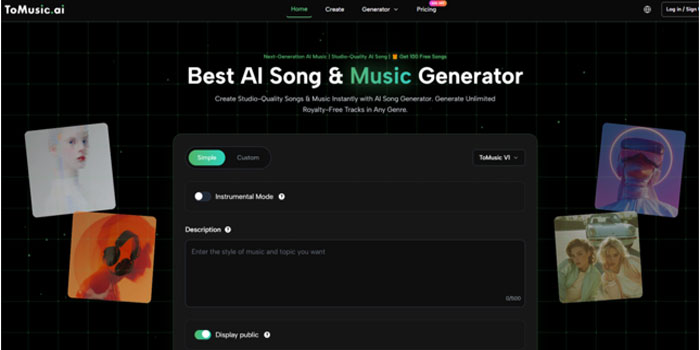
Based on the public interface, ToMusic starts from intent. It surfaces simple versus custom generation, model choice, instrumental mode, and text fields that frame the task as direction rather than engineering. That tells us a lot about the intended audience.
This kind of product design is not accidental. It reflects an understanding that many people who need music today are not primarily musicians. They are creators, editors, marketers, founders, educators, and hobbyists who need workable audio output without committing to a full production stack.
Why That Assumption Feels Accurate
In practical digital work, music is often part of a larger system. It supports a video, landing page, advertisement, teaching material, game concept, or social clip. The user is not always trying to make music as an isolated craft. They are trying to solve a communication problem. A product that begins from that reality is already closer to how modern creative work actually happens.
The Public Workflow Is Surprisingly Easy To Read
A useful review should stay close to what the platform clearly shows. In this case, the visible workflow is simple enough to describe without inventing hidden steps.
Step One Decide Between Simple And Custom
The process begins with a choice between simple and custom modes. This is a smart structural decision because it separates quick ideation from more deliberate creation. Users who want a fast draft can start quickly. Users who need more intentional control can take the longer path.
Step Two Pick The Model And Song Format
The generator interface publicly shows model selection along with settings such as instrumental mode. This step lets the user decide whether the result should lean more toward a song-like output or a non-vocal track. Even without overcomplicating things, this creates a meaningful level of direction.
Step Three Add Description Or Lyrics
Next comes the actual creative input. Depending on the chosen approach, the user either writes a description of the intended song or enters lyrics. This is where the platform’s value proposition becomes concrete. It is asking the user to translate musical intent into language.
Step Four Generate And Refine
After that, the user generates the track. In real use, this is rarely a single-turn event. In my testing mindset, the output should be evaluated as part of a loop. You listen, adjust, compare, and try again if needed. That is not a weakness. It is simply the normal behavior of this type of creative system.
How The Tool Feels In A Testing Mindset
When I think about usability, I try to imagine the first fifteen minutes of contact with the product. That window often determines whether a tool becomes part of someone’s workflow or gets abandoned after one attempt.
The Early Experience Feels Low Friction
ToMusic appears to reduce uncertainty well. The controls are understandable enough that a first-time user can form a plan quickly. That has real importance. Tools that demand too much abstract understanding at the start often create a false impression that the user is doing something wrong, when the real problem is interface design.
The Product Encourages A Drafting Mentality
One of the healthier signals in the workflow is that iteration feels expected. The public product language and generation structure imply that users can explore variations rather than treating every generation as a final statement. That is a better fit for real creative practice.
Why Drafting Matters More Than Perfection
Creators rarely know the best version in advance. They often discover it by seeing or hearing alternatives. A tool that helps them move through alternatives quickly can be more useful than a tool that promises ideal outcomes but makes variation slow or opaque.
The Central Role Of Text Based Direction
The most defining part of ToMusic is not just that it makes music. It is that it frames music creation through language. That gives the platform a very specific identity in the market.
At a practical level, this makes the product much easier to approach for users who already think in narrative, tone, or campaign language. They may not know chords or arrangement theory, but they know the difference between reflective, playful, cinematic, tense, and uplifting. A tool that can act on that vocabulary is solving a real accessibility problem.
Why The Text Layer Changes Everything
That is why the Text to Music positioning is so important. It changes music creation from an expert-first process into a direction-first process. The user does not need to begin by editing sound. They begin by expressing intent. That is a much lower barrier for most internet-era creators.
Prompt Precision Still Shapes The Outcome
At the same time, users should stay realistic. In my observation, better specificity almost always improves the odds of a stronger output. If the prompt is too broad, the result may be serviceable but less aligned with the intended feeling or use case.
What Usually Helps In Practice
Prompts tend to become more useful when they include at least some of the following:
- genre or stylistic family
- emotional tone
- pacing or tempo feel
- instrumental or vocal preference
- context of use, such as ad, video, study track, or dramatic scene
This does not mean prompts need to be long. They need to be informative.
Where ToMusic Looks Strongest In Real Use
After reading the public material and considering the workflow, I think the platform is strongest where speed and interpretation matter more than microscopic control.
Strong Fit For Content And Campaign Work
A content creator often needs music that is good enough, on-brand enough, and fast enough. A marketer may need several tonal variations of the same idea. An educator may want a themed track without commissioning original composition. In those contexts, the value of the product becomes very easy to understand.
Useful For Lyrics Without Production Skills
Another appealing use case is for people who already have words but not composition technique. That group is larger than many product reviews acknowledge. Not everyone who writes lyrics can arrange, produce, or sing effectively in a full studio workflow. A system that turns words into a musical draft has obvious creative utility.
The Product Works Best As An Interpreter
In my view, ToMusic is best seen as an interpreter of creative direction. It is not just a generator in the abstract. It is a system that tries to map language, mood, and structure onto musical output quickly enough to support real projects.
A Grounded Comparison Of Benefits And Limits
A test is only credible if it includes limits alongside strengths. AI music tools are useful, but they are not magic.
Area | What Felt Promising | What Users Should Remember |
Onboarding | Easy to understand and begin | Ease of use does not remove the need for revision |
Creative input | Good fit for prompts and lyrics | Vague prompts can lead to generic outcomes |
Workflow speed | Suitable for rapid experimentation | Best result may require multiple generations |
Accessibility | Helpful for non-producers | Not a replacement for deep manual production tools |
Commercial relevance | Publicly framed for royalty-free use | Users should still choose plans and usage carefully |
The Biggest Strength Is Workflow Compression
The most convincing strength is the compression of effort. The platform appears to reduce the number of steps required to get from concept to playable material. That is more meaningful than a dramatic promise about replacing all traditional music production.
The Biggest Limitation Is Predictability
The main tradeoff is predictability. Like many generative systems, it may not always land exactly where the user hoped on the first attempt. That is especially true when the target is emotionally specific or stylistically narrow.
Why This Limitation Is Manageable
I do not think this weakness destroys the product’s value. It simply means the user should approach it as a guided creative partner rather than a perfect executor. Once that expectation is in place, the workflow becomes easier to appreciate fairly.
My Final Read On The ToMusic Test
What my test suggests is that ToMusic understands the modern creator better than many older music workflows do. It assumes that people want speed, intelligibility, and iteration. It assumes they begin with ideas rather than technical fluency. For a large segment of users, that is the correct assumption.
Who Gets The Most Value From It
The people most likely to benefit are those who need music regularly but do not want every project to become a production challenge. That includes creators, small teams, marketers, lyric writers, and generalists who need fast musical options.
What Makes The Platform Worth Watching
What makes the platform worth paying attention to is not that it eliminates all effort. It is that it reassigns the effort. Instead of spending most of your energy on production mechanics, you spend more of it on direction, comparison, and taste. In many real workflows, that is a better use of creative time.
The Most Honest Summary
In the end, ToMusic feels most persuasive when judged as a practical system for transforming ideas into draft-quality or usable musical results with relatively low friction. It still depends on prompt quality. It still benefits from iteration. It still has the normal limits of generative tools. But in my observation, it does something important: it makes music creation feel reachable for people who previously stood outside the process.
Kaynak:Haber Merkezi