They begin with an image they already trust. It might be a product shot, a portrait, a travel photo, or a campaign visual that already solved the hard questions of framing, color, and mood. That is why Image to Video AI immediately feels relevant. In my testing, the attraction was not that it tried to imitate a full editing suite. It was that it treated the still image as a finished creative asset and asked a simpler question: what happens when that asset is given controlled motion instead of being rebuilt from zero?
That shift matters more than it first appears. Traditional editing assumes you already have footage or that you are prepared to produce it. Image-based AI video changes the order of operations. It says the image may already contain enough visual intelligence to become a short clip, a product teaser, or a more dynamic social post. For small teams, solo creators, and marketers under deadline, that is not a minor convenience. It is a different production logic.
I approached the Photo to Video page from that angle. Instead of asking whether the platform could replace a video studio, I asked whether it could unlock more value from images that already existed. That is a much fairer test, and in many real-world workflows, it is the more useful one.
By the fourth paragraph, the practical question becomes clearer. Photo to Video is not really about decorating a still image with random motion. It is about turning static assets into moving communication pieces with less friction than a traditional timeline-based process. In my observation, that distinction is what makes the page worth testing seriously.
Why This Testing Angle Matters
A lot of reviews of AI tools are secretly reviews of expectations. They criticize a product for not being something it never claimed to be. So for this test, I focused on the exact promise the landing page makes visible: upload an image, describe the result, generate a video, and export it.
A useful test begins with the right job
If a platform presents itself as a web-based image-to-video workflow, then the right evaluation is not whether it can do everything a pro editor can do. The right evaluation is whether it helps an existing still image become a usable clip more quickly and more intuitively than older methods.
That framing changes the verdict. A platform may feel limited when measured against a full production environment, yet feel excellent when measured against the problem it actually solves.
The page is built around an image-first logic
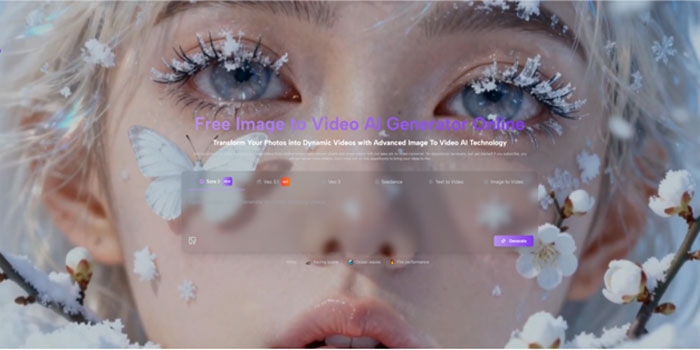
The official flow is easy to understand because the page keeps everything anchored to the original image. The visible steps are straightforward: upload the picture, enter a text description, wait for processing, then check and share the result. The same page also exposes practical settings like aspect ratio, video length, resolution, frame rate, seed, and visibility, which makes the workflow feel more configurable than a toy without becoming difficult to read.
Clarity is part of the product quality
In AI products, clarity is not just a writing issue. It is a product issue. A user is more likely to try a tool repeatedly when the path from input to output is obvious. In my testing, that is one of the Photo to Video page’s strongest qualities. It explains the task without making the task sound mystical.
What I Noticed During The Workflow Review
Before even discussing output quality, the page reveals a lot about who it is for.
It assumes people already have images
This seems obvious, but it matters. The page is not centered on scripting a scene from nothing. It is centered on photos and pictures, which is why the most natural users are marketers, content creators, ecommerce teams, social media managers, educators, and ordinary users with existing visuals.
That is also consistent with the public examples. The site repeatedly points to social posts, product showcases, event recaps, tutorials, and memory-based content. Those are all situations where the source asset often already exists as a still image.
It reduces the fear of starting
A lot of AI video products overwhelm newcomers because their interfaces imply that everything is possible at once. This page feels more disciplined. It narrows the task. You are not here to build a giant project. You are here to turn a photo into a video.
That sounds small, but it is strategically smart. When a platform lowers the cost of beginning, more people are willing to experiment. In creative software, beginning is often the hardest step.
It quietly suggests different output intentions
The available aspect ratios signal that the page expects different publishing destinations. Vertical options make sense for short-form social content. Wider formats suggest presentations, cinematic tests, or website assets. That tells me the product is not treating motion as a single aesthetic outcome. It is treating motion as an applied format choice.
How The Public Process Appears To Work
The visible workflow can be summarized in four short steps based on the landing page itself.
Step 1: Upload the original image
The page supports common image formats such as JPG, JPEG, PNG, and WebP. That is exactly what most users need. It means the workflow begins from existing assets rather than forcing a special file preparation process.
Step 2: Describe your intent in text
The next step is prompt-based. You describe the vision in natural language, and the platform uses that instruction to prepare motion and transitions. This is where the tool becomes more than an automatic slideshow builder. The user is giving direction, not just pressing play.
Step 3: Wait for processing and generation
The page openly references a processing stage and indicates that the result needs time to complete. I appreciate that because it keeps expectations grounded. The platform is not pretending that generative video is instant magic under all circumstances.
Step 4: Check the result and export it
Once processing is complete, the video can be reviewed, downloaded, and shared. This final step matters because it confirms the page is structured around a practical deliverable, not just a preview demo.
Where The Testing Feels Strongest
I think the strongest part of the experience is not a single flashy claim. It is the coherence between the product promise and the visible interface.
The controls are simple but not empty
This is one of the more interesting parts of the page. It gives enough visible parameters to imply genuine control, including ratio, length, resolution, frame rate, and seed, but it does not collapse into an intimidating dashboard. In my observation, that balance is hard to achieve.
A beginner can understand the page without prior training. A more advanced user can still see points of control that affect output style and publishing suitability.
The use cases feel plausible
The public use-case language is grounded. Product showcases, tutorials, event recaps, educational material, memory videos, and social media content all make sense for a photo-based generator. This gives the platform a more practical tone than pages that promise abstract cinematic greatness without showing where the result would actually be used.
The browser-first design changes behavior
Because the page is web-based, it subtly encourages quick trials. A team member can test one image, then another, then a vertical variation, then a different prompt direction. This kind of repetition is exactly where a browser-native workflow has an advantage over heavier desktop editing habits.
Iteration matters more than perfection
In AI video, a platform does not become useful because the first generation is flawless. It becomes useful when repeated attempts still feel reasonable. In my testing mindset, the Photo to Video page seems designed for that kind of iterative use.
What The Page Suggests About Output Quality
A public review based on the landing page has limits, so the most honest approach is to talk about what the page strongly implies.
The platform aims for polished short-form motion
The wording around natural motion, clean transitions, and polished video suggests the target is not raw experimentation alone. The intended result seems to be content that is presentable enough for actual posting or showcasing.
Resolution choices show ambition beyond novelty
The presence of multiple resolution options, including higher-quality output settings, suggests that the platform is not treating the result as disposable only. Users are clearly being invited to think about final presentation quality.
Audio appears to be part of the premium story
The broader site also suggests that subscribed users can access higher-quality videos and stronger audio synchronization features in some workflows. That is notable because it implies the product vision is expanding beyond silent motion into more complete short-form content.
The Limits A Serious User Should Keep In Mind
No honest test should hide the weak points of the category.
Prompt dependence is unavoidable
The more a tool relies on natural language direction, the more the result depends on the quality of that direction. A vague prompt often leads to generic motion. A clearer prompt usually produces a more usable clip.
Existing images set the ceiling
A strong image helps enormously. A weak or confusing source image can only be improved so much by motion. The platform can animate, but it cannot fully repair a poor visual starting point.
Some users will still want a full editor later
That is normal. A browser-based image-to-video page is excellent for generation and fast iteration, but some projects will eventually need deeper trimming, sequencing, captioning, or compositing elsewhere. That does not weaken the page’s value. It simply defines its role honestly.
Why This Test Left A Positive Impression
My main takeaway is not that the page tries to do everything. It is that it does a good job of narrowing the job to something people actually need. Many teams already have still assets. Many creators already have images with clear mood and composition. What they lack is a fast path from stillness to motion.
The Photo to Video page understands that bottleneck. It is less interested in making users feel like directors and more interested in helping them create short, dynamic outputs from images they already own. In a crowded category, that practical humility is a strength.
If I had to summarize the test in one sentence, it would be this: the page feels less like a fantasy about AI filmmaking and more like a believable workflow extension for static visual assets. In real work, that is often the better product strategy. It means the tool has a clearer role, a clearer audience, and a clearer reason to be opened again tomorrow.
Kaynak:Haber Merkezi